
'Running' Through the Female Line: A London to Brighton Dynasty
)
Sarah Tunnicliffe, her daughter Sabrina and Sabrina’s siblings William and Caroline are the second and third generation of what might be viewed as a London to Brighton dynasty, and one in which lady drivers have played an equal role since the beginning. And there’s a fourth generation waiting in the wings.
Sarah, her children and grandchildren have all grown up taking part in the Veteran Car Run since early childhood – as Sabrina says, “It’s been part of my life forever and that’s true of my mother too. It’s always been something my family has done – the Run is what November’s all about for us.”
From Bullnose Morris to the world of veteran motoring
The family’s involvement with historic cars began when Sarah’s father, Brian Moore – who she describes as “A leather manufacturer but an engineer by instinct” – bought the chassis of a 1922 Bullnose Morris. He completely rebuilt the car and that fired his passion. Brian and his wife, Sarah’s mother Ruth, went on to buy ‘Victoria’, a 1903 De Dion Bouton. They drove Victoria on their first Brighton Run in 1964 and that was the start of a 60-year-and-counting family tradition that now encompasses four generations of drivers and passengers (and future drivers). And one which has always involved lady drivers.
Sabrina notes, “It’s still quite unusual for women to drive on the Run but in our family it’s been encouraged for the women to drive. It’s a full-on involvement. Starting with my grandmother, our family was very, very keen that it wasn’t just a case of ‘this is the boys’ pursuit and the women come along to look pretty’. It was always something we did as a family, so everyone learnt, everyone was expected get out of a car and push it up a hill and take their turns driving and navigating.”
‘Victoria’ was soon joined by two Panhard et Levassors: an 1892 model that the family referred to as the ‘Little Panhard’ and a 1902 example – the ‘Big Panhard’. The latter is, Sarah says: “A very powerful car and quite iconic – it took part in the last race at Brooklands before the Second World War after which it was no longer possible to fully drive round it. So really it was the racing car of its time and it’s still a car that can go very fast. And with no windscreen and no hood it’s quite adventurous. In November you have to wear a lot of warm clothes…”
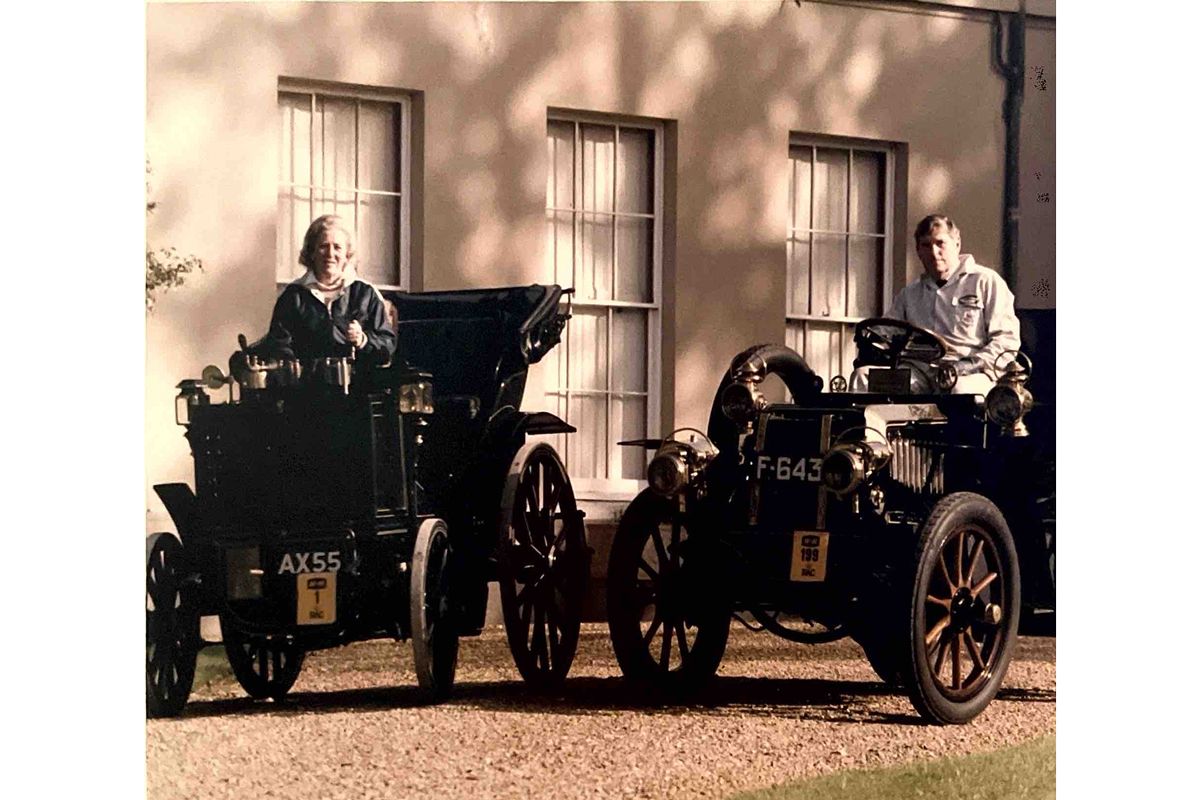
Ruth and Brian Moore on the Little Panhard and Big Panhard
The Little Panhard: waving the flag for lady motorists
The 1892 car was usually the oldest or one of the oldest vehicles on the Veteran Car Run, so would either start first or very early in the running order, the occupants all enjoying being at the head of the pack for a few hundred yards or so before the slightly younger cars caught up.

The Little Panhard was universally acknowledged to be Ruth’s car, as Sabrina describes: “That car was very much her domain, and I never saw my grandfather drive it. Even though it could only travel eight miles an hour and required pushing up the hills, it was almost always an all-women car. For a time when we were little, she was accompanied by my father’s sister, who was a Cambridge University rower and very strong, which was certainly useful.
"My mother also would regularly travel with my grandmother, including on the Run in 1992 when the car was 100 years old (shown below). My sister and I were always told that when we were old enough, we would get to drive down to Brighton with my grandmother on the Little Panhard as well. My sister Caroline did it when she was 16 or so and I went a couple of years later and it was a really special experience.

"At the time I didn’t think about that being significant on a feminist level, but looking back now it was; it was a family rite of passage for my mother and us girls and showed everyone that driving veteran cars, even the oldest and most challenging, does not require a man behind the wheel.”
Brian and Ruth Moore each served as President of the Veteran Car Club – Brian from 1999-2001 and Ruth from 2013-2015. She was the first, and remains the only, Lady President of the Club. During her Presidency Ruth organised the first VCC Ladies Rally with a route around the Cambridgeshire and Suffolk lanes and a leisurely lunch at Newmarket Racecourse. Lady drivers came from all over the country with their cars to enjoy the day. The Moores continued driving on the Veteran Car Run into their seventies and eighties, with Brian receiving his 50th Run medal in 2016, the year before he died.
Growing up with veterans
Mother and daughter each speak about experiencing the Run as very young children. Sarah recalls her earliest experiences of the event as being “Absolutely freezing cold. But it was really fun and quite an experience - there used to be so many people lining the streets years ago, and all the lights were stopped in London and in Brighton.”
Sabrina adds, “I remember being in ski suits at the age of 3 or 4 and of course we always just loved waving to everyone. It was a long day on the car, but it was such fun, you felt like celebrity.”
Sarah’s childhood and teenage experiences of historic motoring extended beyond the Veteran Car Run: “We were very lucky, we went to the Expo Exhibition in Canada in 1967 and Dad took over the 1922 Bullnose Morris on a ship and we rallied it there. And we took it to Australia in 1970 and also to South Africa when I was about 15. We also went on a rally from London to John O’Groats and back to London on the Big Panhard.”
Even the Veteran Car Run was extended into a longer driving experience than it is for many: “For some years my parents would drive the veteran cars from our home near Cambridge to London for the Run, stay the night in London, drive them to Brighton the following day, then spend the night in Brighton before driving them all the way back to Cambridge.”
Having grown up immersed in the world of veteran cars and the Brighton Run, it’s not surprising that Sarah and her three children were all able to drive veterans from the age of 17 or so.
“I started driving them when I was able to off-road before I was 17 and then on the road as soon as I legally could,” she says. “Learning to drive an old car as a young person as opposed to learning later in life is a bit like learning to ski or swim as a child – somehow you learn it better because it becomes intuitive to you.”
Sabrina’s experience was similar: “Once we got to the age where we passed our driving tests, the family were very keen to get us on the old cars, so we would do lessons with my grandfather, who was actually a great teacher to me and my sister and my brother, though at times not the most patient! I learnt to drive a veteran car at 17, the same time I was learning to drive a ‘modern’ car, but that car was an old Land Rover with really heavy gears and, frankly, there wasn’t that much difference between the two! I think it’s much more daunting to learn to drive a veteran car when you’re in your thirties or forties, when you’ve been driving modern cars for many years, and also you have the perception of danger which most people don’t have to the same extent when they are in their teens.”

Caroline with her grandmother Ruth on 'Victoria'
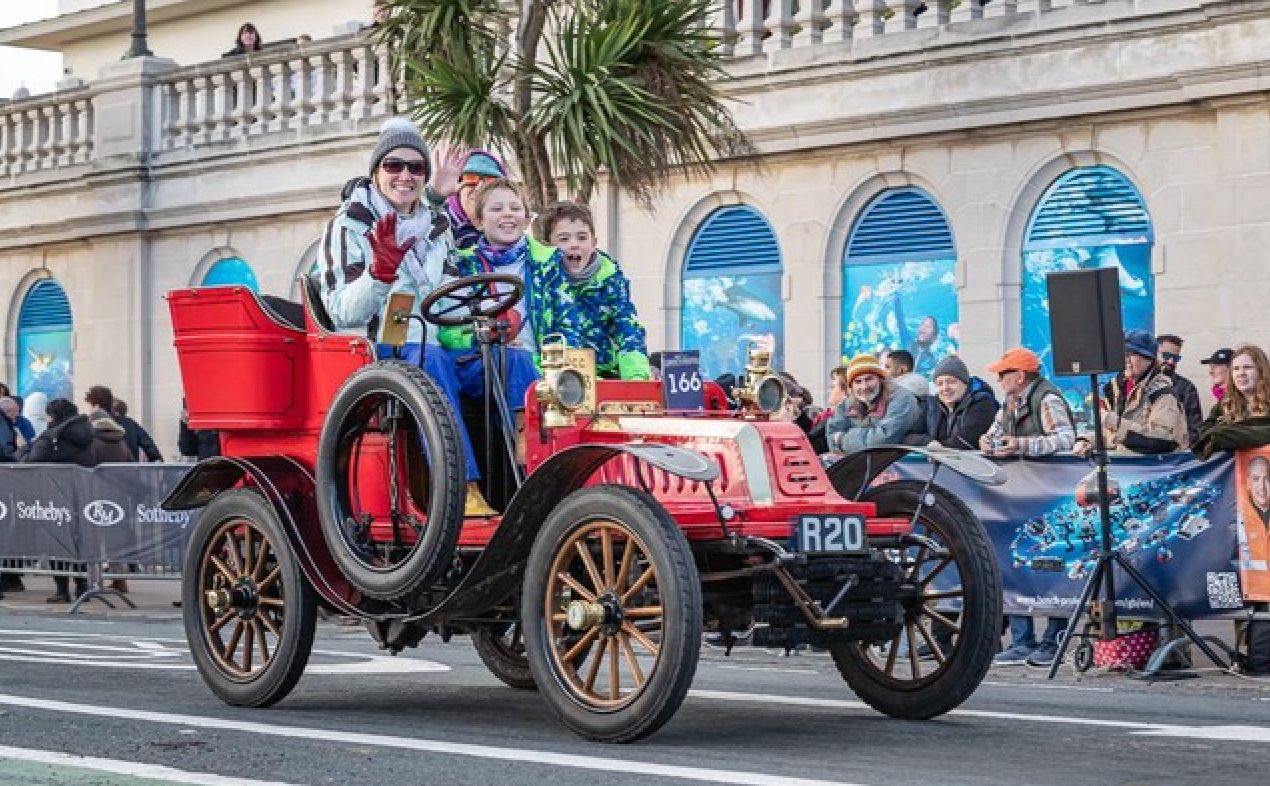
Caroline driving her son Henry and nephew Max (Sarah: "The grandchildren tend to swap about")
Custodians of the past
While Ruth’s Little Panhard is no longer in the family’s ownership, Victoria, the 1903 De Dion Bouton, and the 1902 Big Panhard still remain in the fold. Not surprisingly, there is enormous fondness for the vehicles which, as Sabrina says, “Have been in our family longer than they've been anywhere else. We think about them as very old, but actually we've been custodians of them for the vast majority of their life.”
Sarah describes Victoria as a “lovely car – very dependable. The only trouble is that really you can only have two adults or two not very big adults and two small children on board because she’s not that powerful.” Sarah’s son William is driving Victoria to Brighton this year, otherwise his sister Caroline would have been behind the wheel, while Sarah will drive the Big Panhard.
Sabrina is driving the family’s 1902 Darracq (shown below) this year: “I’m terribly fond of it, even though the car does like to give us quite the runaround pretty consistently. It feels like a very honest car - for example if it is going to break down it breaks down on the Run when it's going to pour with rain. It did this in the torrential rain in 2022 – it broke down just after Westminster Bridge, and I must admit I’ve never been so grateful! It’s also quite keen on nearly breaking down a few miles from Brighton. I then limp it into Brighton and my parents frown, thinking ‘what have you done to the car’ but we made it!”
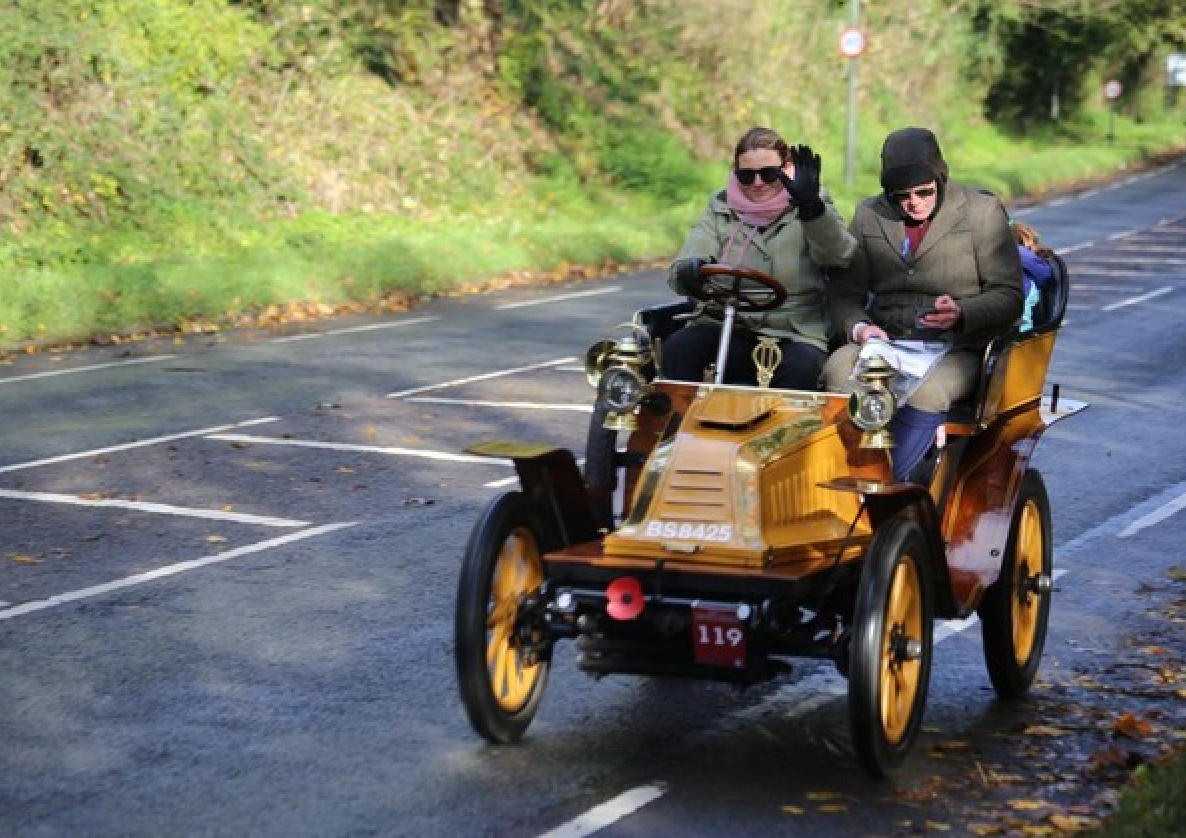
Sarah and Sabrina have a very similar view of driving veteran cars on today’s roads. Sarah: “I think driving one of these makes you a better driver of a modern car because you’re always, always looking ahead. The brakes on these cars are really not very good and your main brake is a handbrake. With the De Dion, you have to put the car out of gear and put the handbrake on and there isn’t a footbrake. There is a footbrake with the Panhard but it’s not a particularly strong one, so you have to be attuned to your surroundings, and concentrate to an extraordinary level. It can be physically and mentally exhausting because you do hold yourself unconsciously quite tensely.”
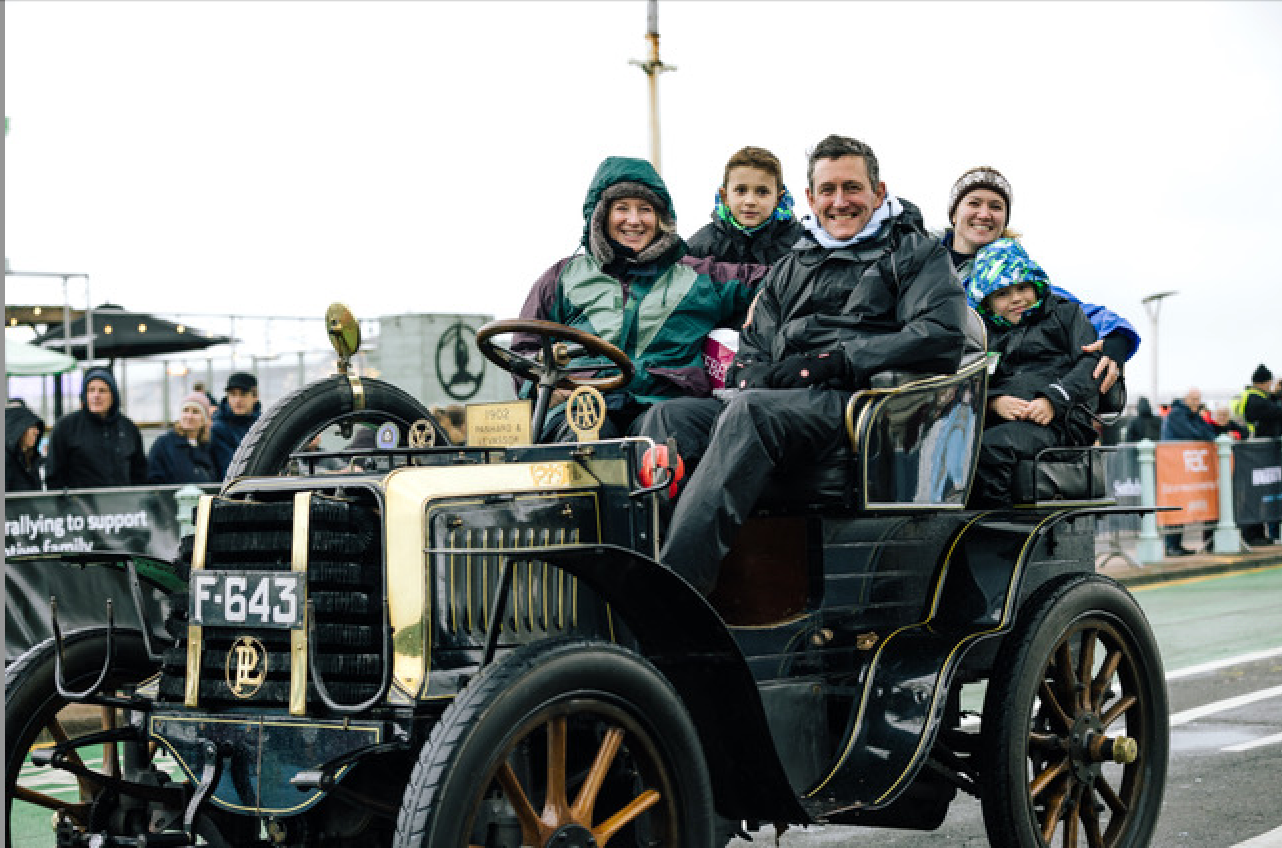
Sarah at the wheel of the Big Panhard
Sabrina concurs: “The London to Brighton Run is always a real challenge to drive. It’s a long and largely continuous drive because many of these cars are not very fast (though my Mum could zoom down in the Big Panhard in two and a half hours). So I always alternate driving on the day with my husband. We split it into quarters because of the concentration element and because we have our children in the back. None of us rush to reach the finish. We enjoy the day, meeting at the coffee stop and a pub near to Brighton for lunch.
“My sister and I often comment to each other that when we were children we never thought about the fact that we weren’t strapped in. I would never dream of taking my children in my modern car – which is a steel cage with laminated glass windscreen etc. – without them wearing a seatbelt. Yet we pop them into an open car, no seatbelts, in November, and drive through London! It means that you’re not going to take a risk – in my view you need to be a more conservative driver when driving these old cars.
“The other thing which is really relevant nowadays is the amount of traffic on today’s roads compared to 25 years ago when I was first driving on the Run. The event is really well managed, with so many marshals etc., but you need to be so aware of other road users. For example, you can’t do an emergency stop or, rather, you can, but it takes time. It’s got harder driving them amongst modern traffic – though it’s definitely easier pootling around country lanes on the Summer Run, which is a great way to get used to it. When you do arrive in Brighton there’s a wonderful exhilaration because you’ve got there, and also a sense of relief that you did so without incident!”
Sabrina also comments on another aspect of veteran motoring: “The whole veteran car movement is so friendly. If you have a problem with your car and you see someone with the same make of car and ask them for help they are so kind. You want to help fellow motorists and keep the whole thing going – we all have to band together and make sure everyone supports it and appreciates it and that it’s not forgotten in history.
Looking to the future
Sarah: “It’s great to be waving the flag for women – and to be one of three generations of women who have done this so far. My older daughter Caroline has also driven lots of times, and now there are grandchildren who I think will take it up. It’s hopefully a tradition that will continue.”
Sabrina: “It's been a family passion and love for as long as I can remember. And now I have my own children, and the Brighton Run is also firmly in their calendar. My parents have four grandchildren - three boys and one girl – aged from 8 to 11. So we've got a few years before they're going to be agitating to drive but I can tell you now that is exactly what will happen!
“I think it’s so fabulous, and I can just imagine my grandparents looking down from on high, just being so utterly thrilled that four generations have been involved to some degree or other. So, watch this space, give us another seven or eight years and hopefully you’ll see the fourth generation driving.”
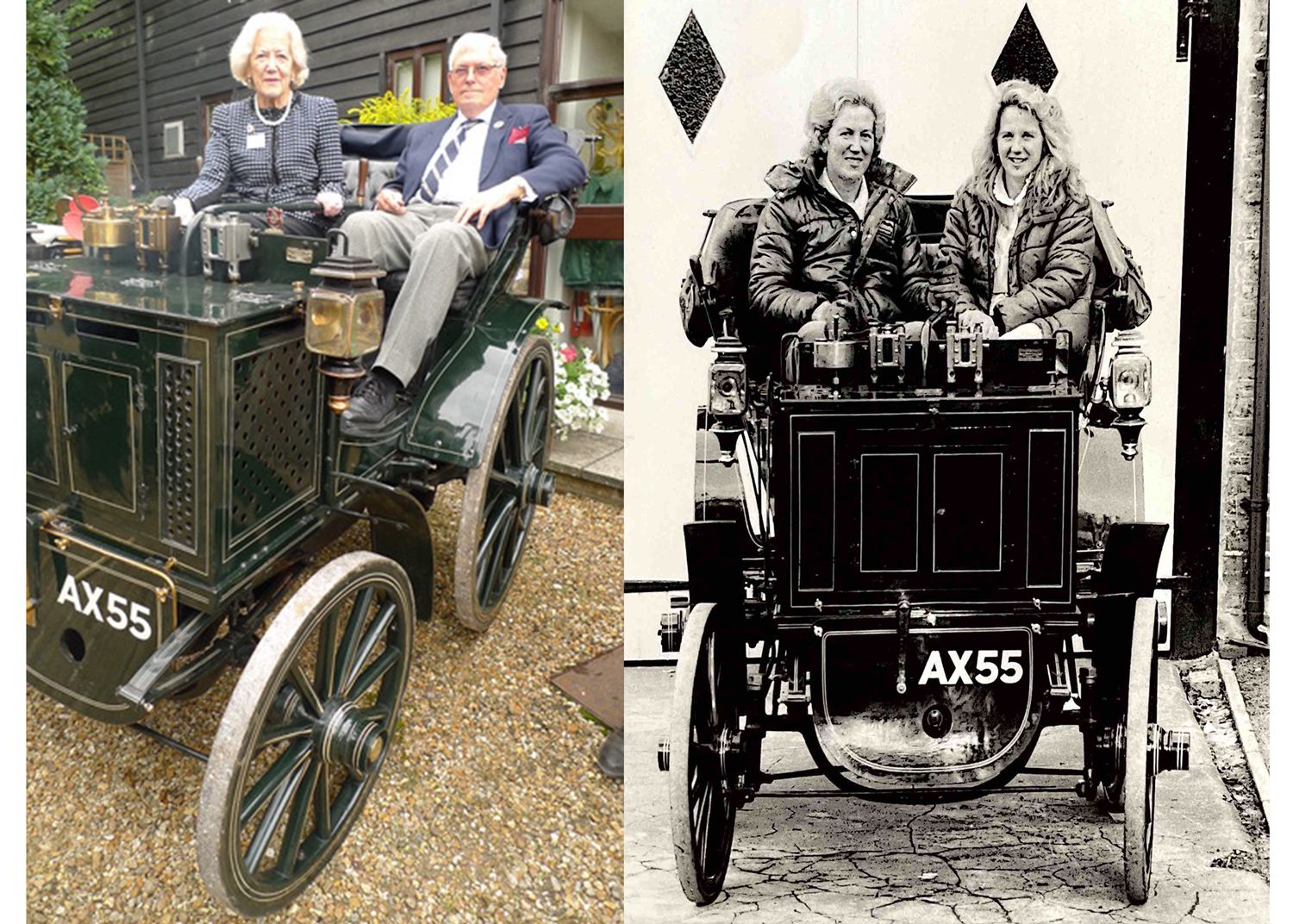
Ruth and Brian Moore / Ruth and Sarah



.resize-500x189.png)