
Putting Richard Stephens back in the heart of Clevedon
)
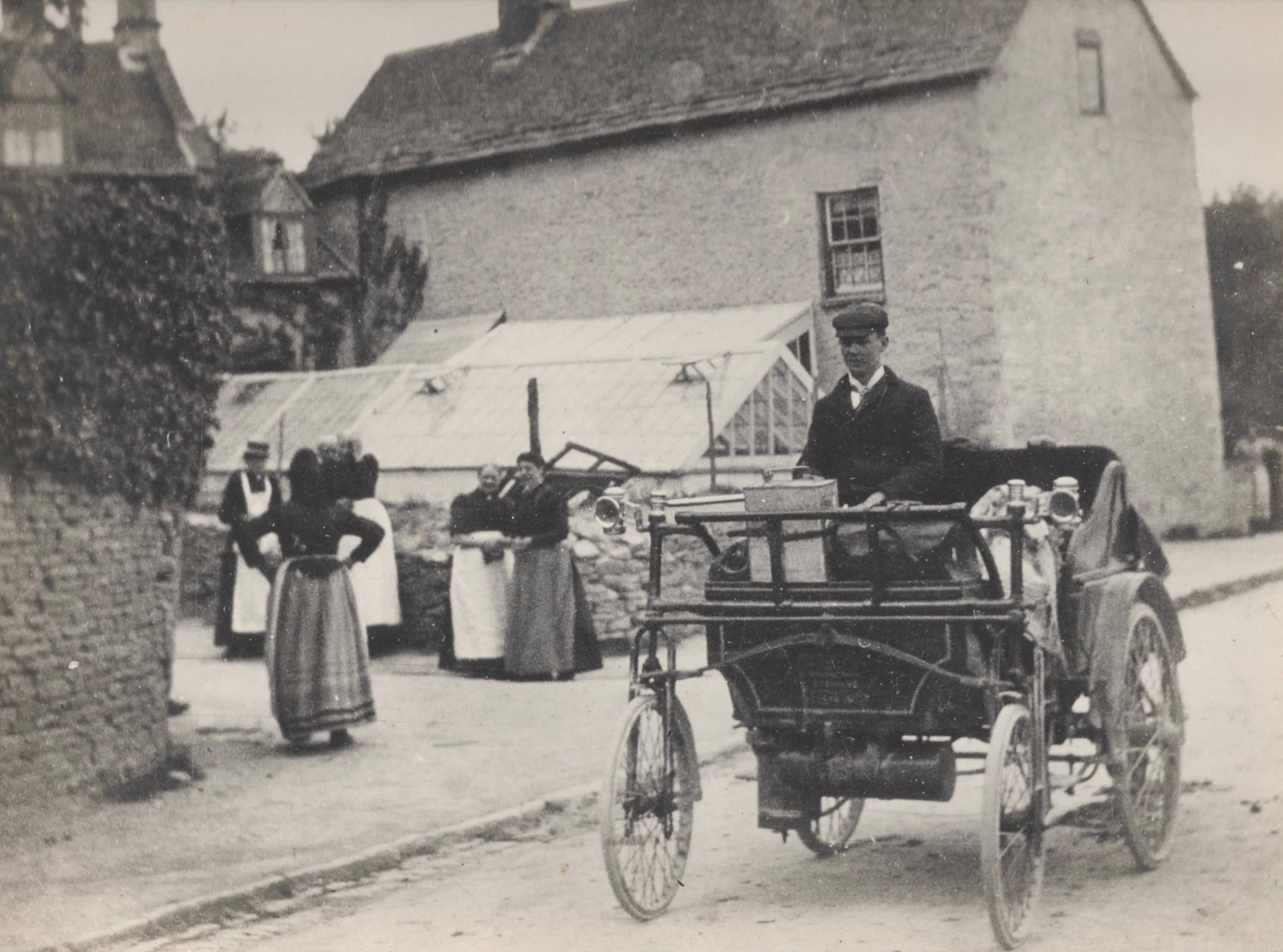
This is the story of a passion project, the tale of how a Californian's love for his adopted British town and its place in England's earliest automotive history inspired him to create something remarkable - a 1:1 recreation of Richard Stephens' 1898 prototype motorcar, which went proudly on permanent public display in July this year and has already won an award. And that's just the start of a story which is still evolving.
Mark Reber is tenacious - if he has an idea he runs with it. Now a UK citizen, the Californian-born televison and film director has lived in four countries but has been happily settled in the small Victorian seaside town of Clevedon, Somerset since 2021.
Were you always a 'car guy' even before you immersed yourself in the world of Richard Stephens?
Yes - I started in the States with American V8 muscle cars, which my Dad helped me maintain. My particular loves are 1960s and 70s sports and GT cars - Shelby Cobras, GT40s, Bizzarrini, Monteverdi... And in 2022, I thought it would be fun to introduce the kind of laid-back car meets I'd known in the USA to Clevedon, which is how the Clevedon Cars & Coffee events began. I had no idea of the town's role in motoring history at the time.
Clevedon Cars & Coffee meets in the town on the second Saturday of every month. It’s free. There’s no pre-registration. Clevedon becomes a time machine based on the age of the show cars. 1890-1960 meet in old Clevedon at Queens Square where the Stephens Factory was. Any visiting Veteran Car Club member would be at home there. 1960-1999 get SixWays and 2000-present get Salthouse Fields. In total we get 350 cars or more.
How did your fascination with Richard Stephens and his motorcars begin?
Clevedon Cars & Coffee had been running for about a year when I learned that the town had its own links to the earliest days of motoring - Richard Stephens. I read William Fairney's book 'Richard Stephens and the Clevedon Motorcars',and realised that the car show I was running was not an imposition on the town of something that wasn't germane to it. It turned out that it was reviving something very old about the town.
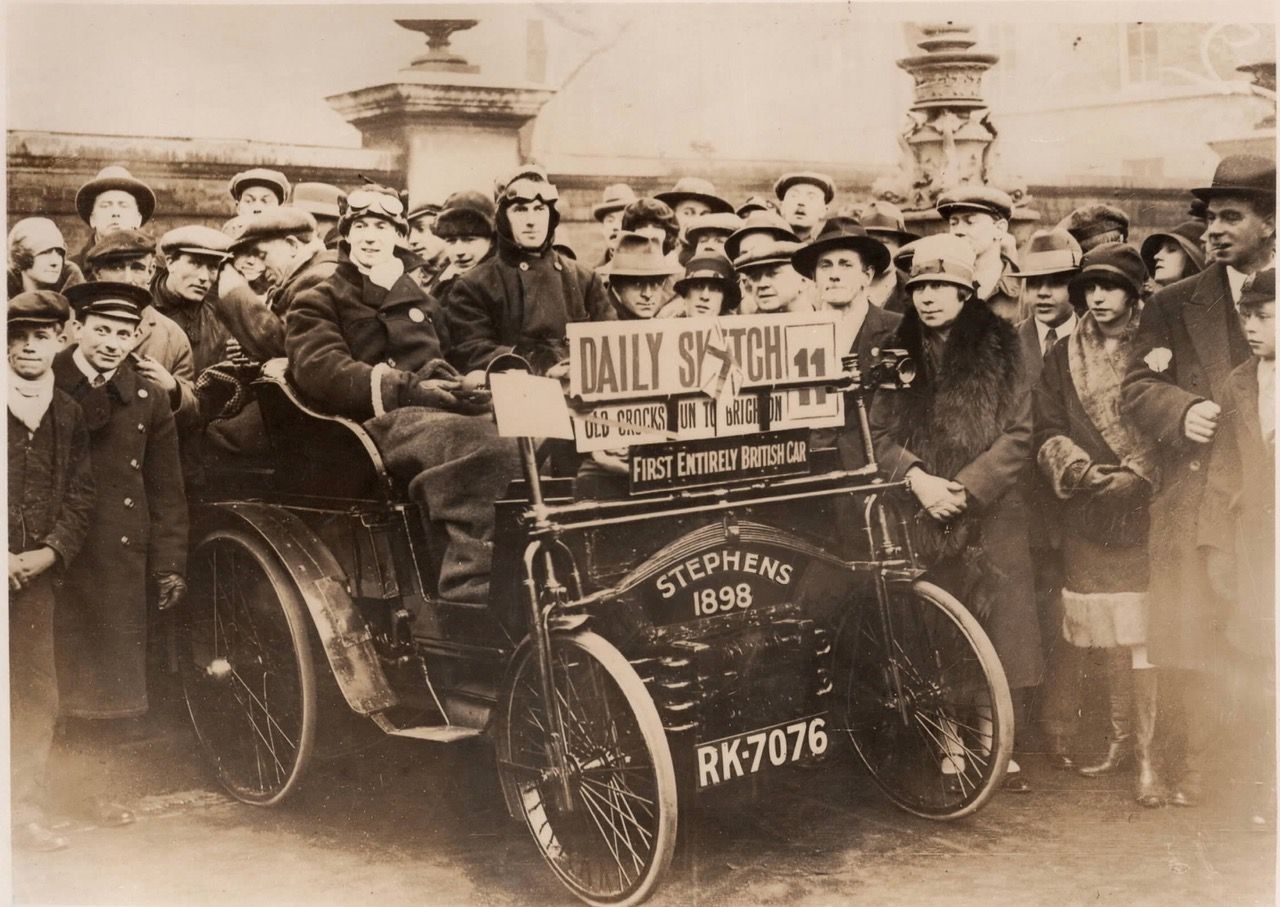
Imagine you moved to a town that you only know from the TV series Broadchurch. And it turns out that it is the town where what appears to be the first branded British motorcar series began. Or what Richard Stephens believed to be, and promoted as, the 'first entirely British car' - he even fixed a sign saying exactly that onto some of the cars. And it was a belief he held his entire life, fuelled by the knowledge that other car manufacturers in Britain in 1898 were utilising Peugeot and Benz components.
In reality there were others who also spurned overseas components, but he wouldn't have known of them - mass-communication wasn't at its height in the late 19th century. Stephens died in 1932 not knowing that the Frederick Bremer car from 1894 and John Henry Knight's 1895 three-wheeler had beaten the first-ever Stephens car, produced in 1898, by a few years to that 'first entirely British car' accolade. And I'm rather glad he did never find out! Those rivals were fleeting, one-offs. Stephens built 12 vehicles under his own brand, and he probably doesn't have a British rival for that in 1898.
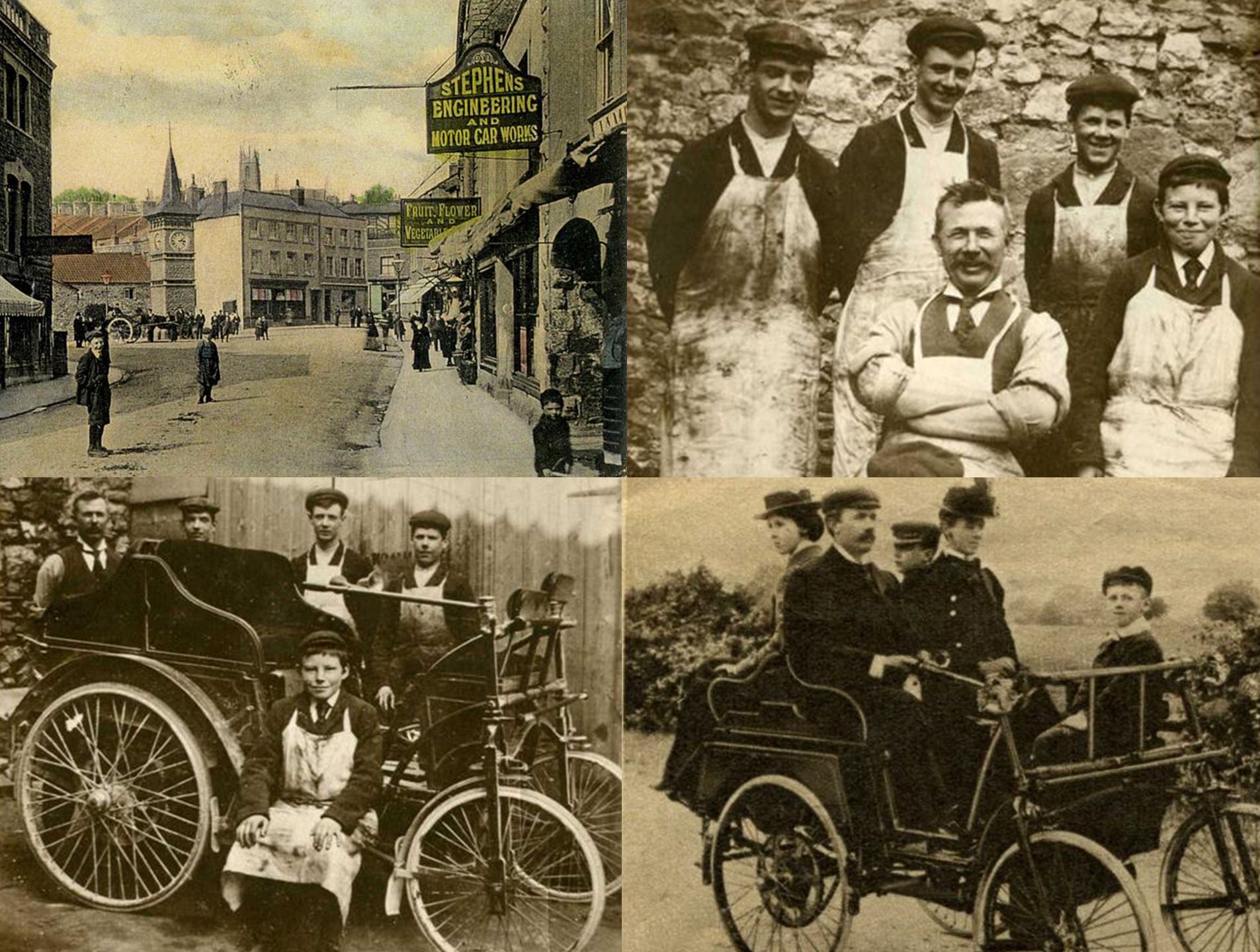
The story of how a bankrupt Welsh miner with no formal education managed to design and build a dozen motorcars and launch a global aftermarket industry, all from this small town, fascinated me. To learn how Sir Edmund Elton, baronet and inventor, recognised Stephens' genius and bankrolled Stephens Engineering and Motorcar Works, and to discover the story of how carpenter William Shopland crafted the Stephens wooden dogcart frame was inspiring. And, perhaps, for me, the most remarkable element was the fact that, although he built cars, Stephens didn't sell them - he sold tickets. Because he used those cars to operate a public transport system for the area.
A public transport system?
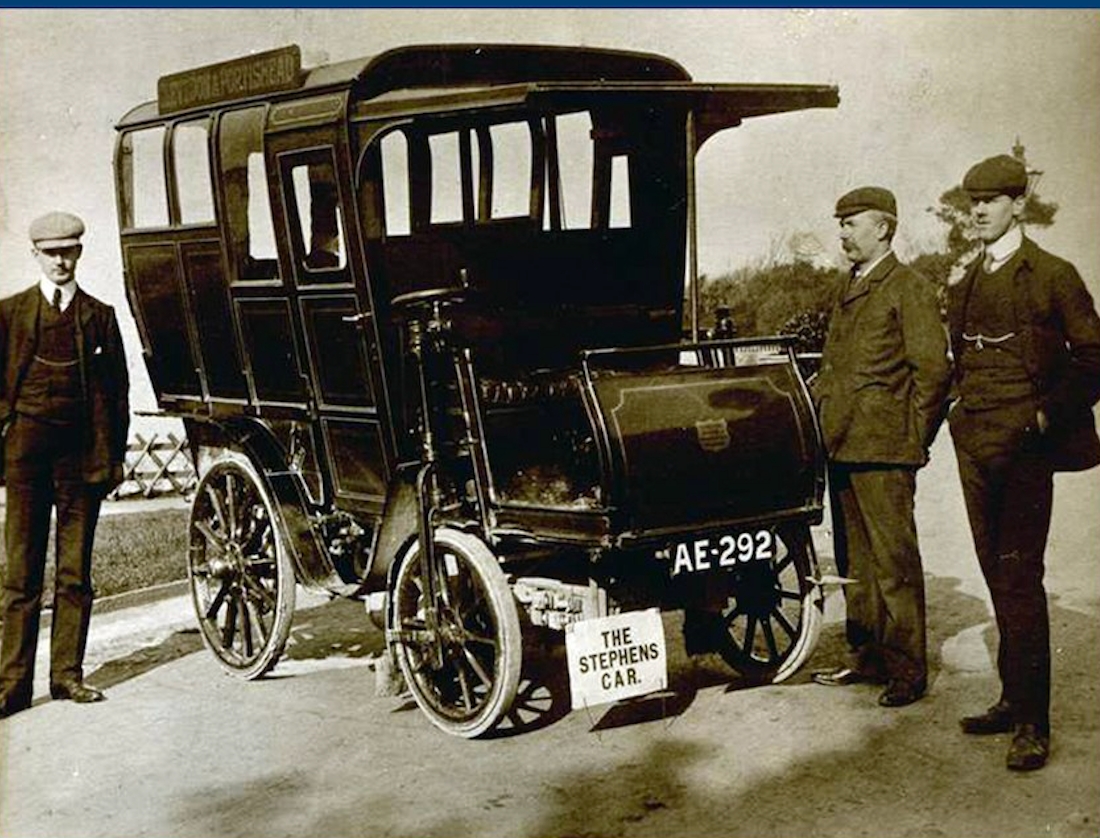
This is what makes the story even more special to me. Stephens' series of 12 vehicles concluded with a 10-seater omnibus, for which he expanded his prototype's frame. They were not built for sale. Right from the start - 1898 - he ran a regular bus service. In this same year what's generally regarded as the UK's first licensed motorbus service started - using Daimler and MMC cars in Edinburgh. But the other early services generally covered relatively short distances, usually within a town. Stephens covered much wider areas, going as far south as Taunton, as far north as Gloucester. His service included Wells, Portishead and Weston-super-Mare. And it ran every day except Sunday.
Although he had no affiliation with the Great Western Railway (GWR) his vehicles were painted in GWR brown. Travellers could get off a train in Clevedon and continue on the public transport service with an apparent seamless hop onto a Stephens' car or omnibus, and he'd whisk them off to destinations.
So your idea...
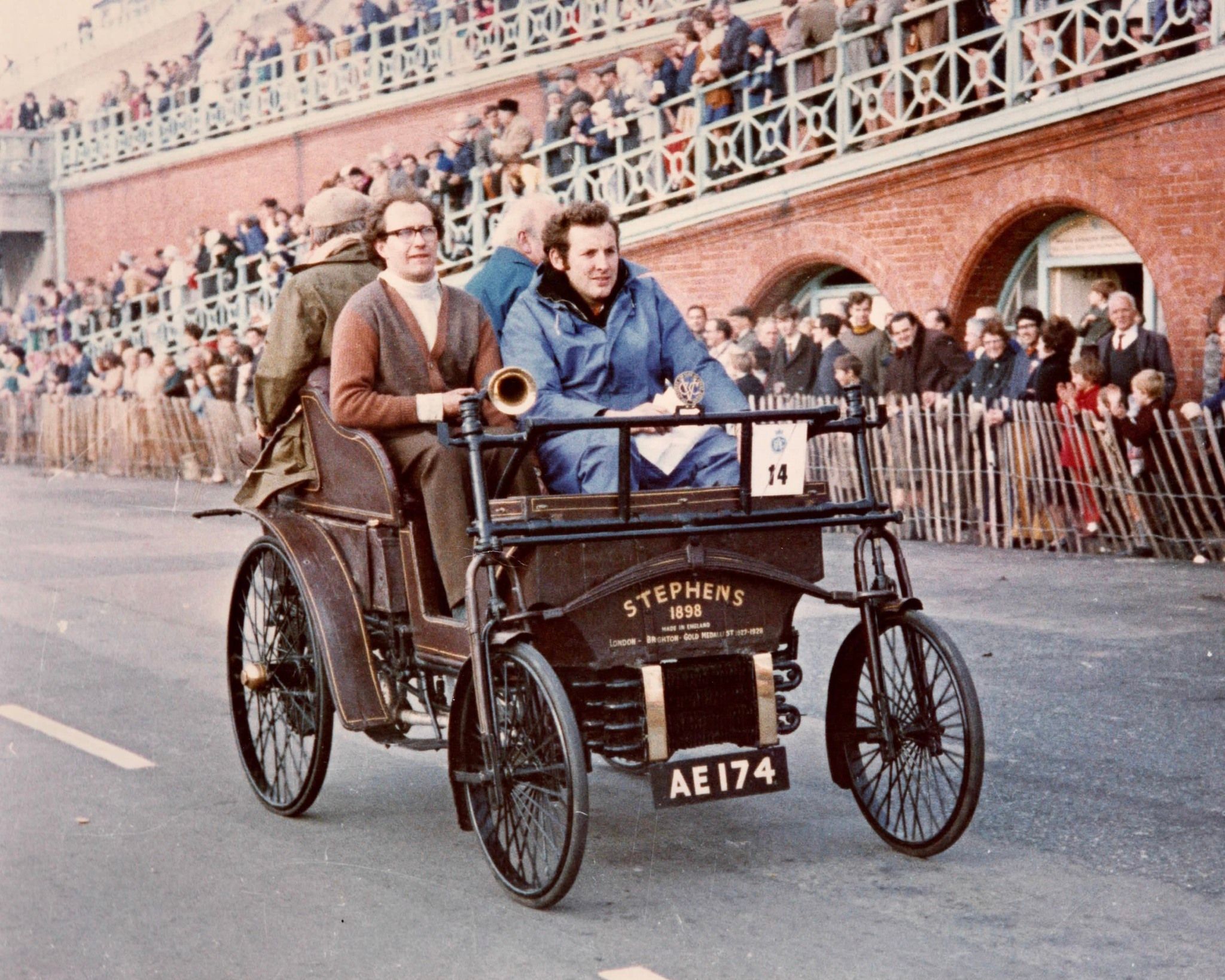
Once I'd learned about Richard Stephens, and that there were just two of his cars remaining - the 1898 prototype AE 174 and the 1900 dogcart AE 341, which have been owned by the Loder family since they bought them from the Stephens family in 1969, I thought, "well, we've got to get them out here." They hadn't been in Clevedon since 2006, when Julia Elton, the great-great granddaughter of Sir Edmund Elton had arranged an event which had been really well attended. And this thought lead to another, a permanent celebration of Richard Stephens' achievements in the form of a monument.
One thing that's great about being a Yank is you don't know better. So, I hadn't been beaten down since I was a kid with how hard it is to get through British bureaucracy. And I now know how hard it is, but it was worth it.
In June 2024 I arranged for William Fairney to come to Clevedon and make a presentation about Richard Stephens to the Clevedon Civic Society, members of the town Council and members of the public. After his presentation I announced that I would like to put a monument to Richard Stephens on Six Ways roundabout in the town. A one-to-one reproduction of his original car. And the room went crazy. They were so excited about it.
Forgetting that I'd never built a monument before, I just talked everyone into it, and off we went to do it.
It's one thing to have an idea, it's quite another to execute it. Talk us through the process of building the monument
The first step was to arrange to meet Christopher Loder, owner of the 1898 Stephens prototype. I didn't know him and had no idea whether he would be amenable to us coming and taking measurements of the prototype and learning about it. As it turned out, he was thrilled.
I went to see it for the first time in early October 2024. I photographed it and used the 3D scanner on it, but the most useful thing - and I think the Victorians would appreciate this - was that I brought a giant roll of paper with me and stretched it over elements such as the transverse leaf spring in the front. And then, with a crayon, I was able to get the exact curve of the car just as it really is. There's no value in having a 3D model when you're having to create it through blacksmithing. You actually need to be able to take a bit of bent metal and see if you've got the curve right.
Then I had to figure out how to make the monument, and to do it affordably. Quotes were coming in at around £45,000, which just wasn't doable. So I said, "okay, well, I'm just gonna make it myself then, then."
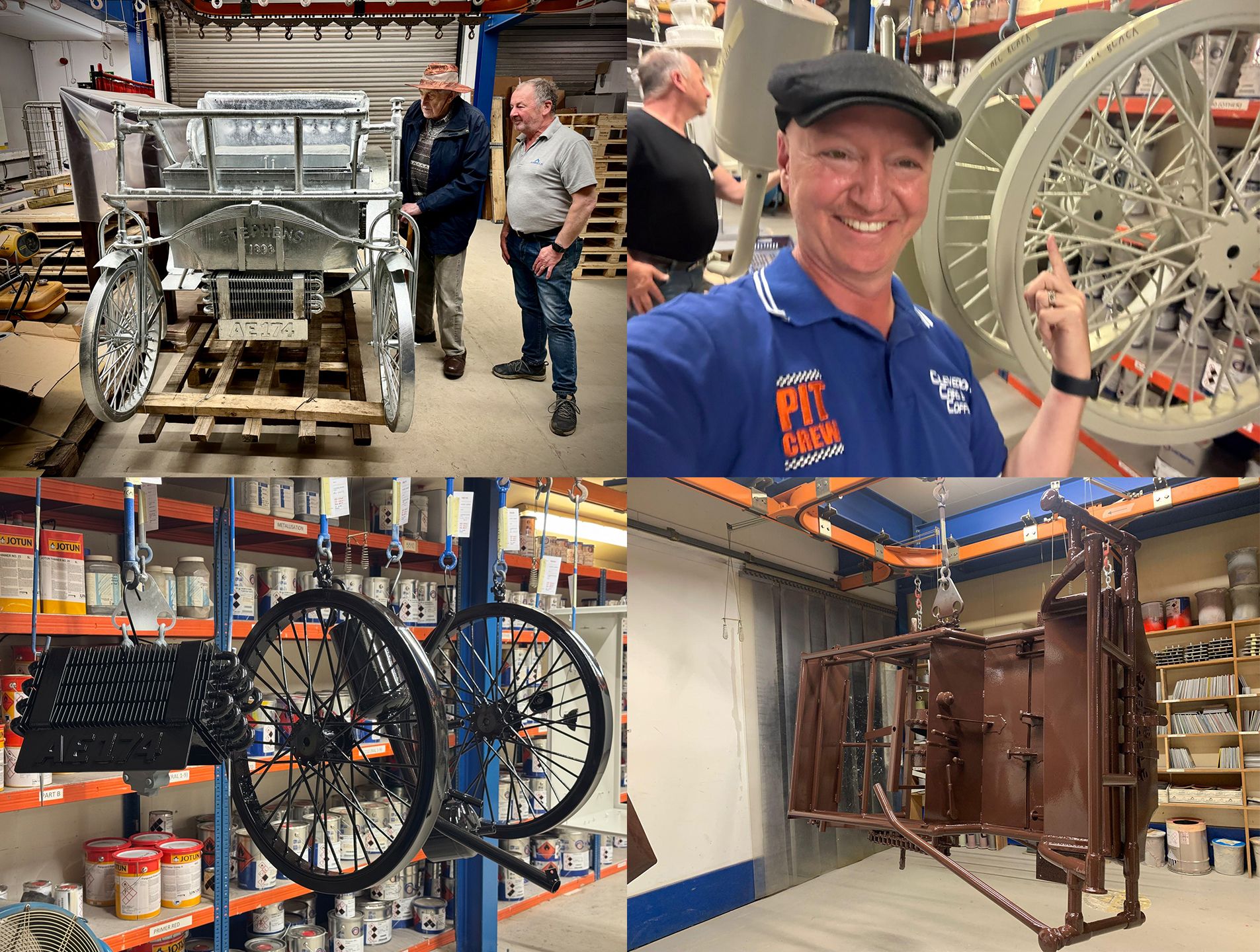
Luckily I knew just the person to do it with - a friend of mind in Lincoln, Ryan Atkin of Ryan's Iron. He's a very good blacksmith and a very good welder. In order to keep his costs down I temporarily moved to Lincoln myself, staying at the Lincoln University campus to further reduce costs. And I worked on it with him. The process took about six weeks.
Ryan had never built anything like it, and neither had I, but fortunately Lincoln was the birthplace of the tank in World War One, and there is still a tradition of steel working in that area, and there are some great specialists. If you take them a square section, a piece of hollow tube, they can bend that into a circle for you, and you'll have a tyre in no time. This meant that Ryan and I could go to a couple of people for custom work like that that we couldn't do perfectly ourselves. The 88cm tall back wheels of Chris's Stephen's prototype were replicated by just taking a piece of straight section and having them curl it for us. We employed a little creative license to make sure it was stable enough, so instead of 6mm, we might go to 8mm for spokes, that kind of thing. Just to make sure it could handle all the traffic it would get once on public display.
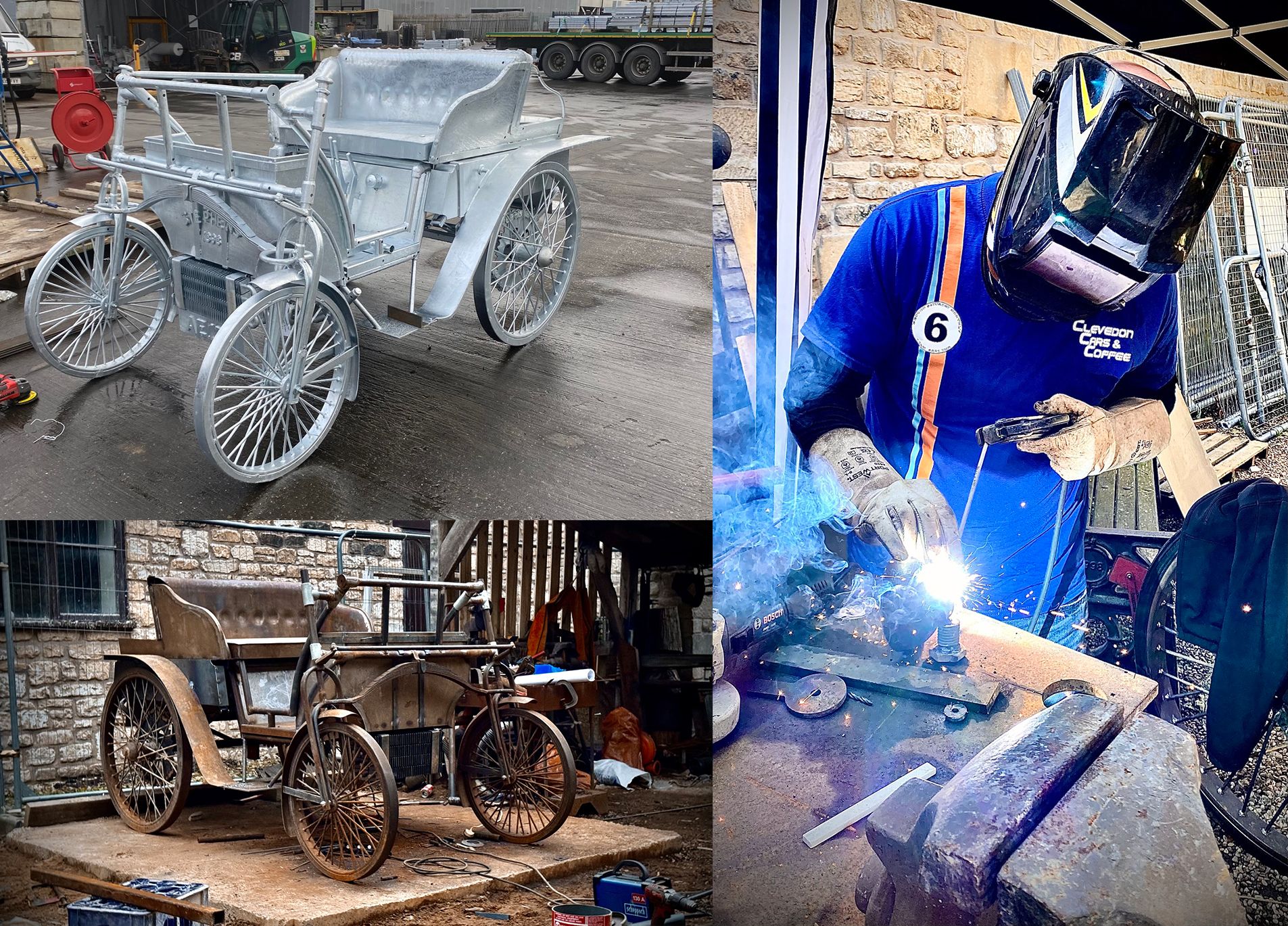
The main worry for us was galvanising. Clevedon sits on the Severn Estuary and, naturally, the environment here is not good for metal. I didn't want the project to rust from the inside out, so galvanising was vital. But the process employs molten zinc and nickel and has to be really, really hot, and can distort everything that goes in there. It's like sticking your project into lava and can even distort RSJ beams.
The crucial element is letting gas release. If you have a steel tube - and the Stephens is essentially two bicycles put side by side - and if the galvanising can't flow rapidly right through the inside and then out, it will have heat build-up in the submerged part. And the difference between that and the cool part will make the metal buckle. So, I was nervous. Fortunately, Tony Linsley came down from Humber Galvanising in Hull, looked over our project and advised us on how to avoid getting air trapped anywhere, as trapped air can lead to explosions. Thankfully, with his guidance, it all went well.
The next step was to source a paint coating which would be exceptionally durable. And here's where we had a stroke of luck. Amitec, the number one specialist in the country for coating things such as the reactor parts for the new EDF reactor we have down here, is based just a few miles from Clevedon. They have a marine coating system which they use on deep sea oil rigs, a high-tech, two pack, resin polyester kind of a paint. Amitec's Managing Director, Andrew Maynard, is a car fan - a Jaguar fiend who owns one of the very few XJR-15s. He's hardcore - and he coated the monument free of charge, colour-matched to the GWR brown of the original Stephens. This is by no means an inexpensive process, so I think Andrew's contribution to the monument is the largest in cost terms of all the work we've done. And it's also given the monument the longevity it needs.
Are we right in thinking that you built the monument without having permission to site it?
Yes - it's the American in me again… I believe "show business" beats "tell business”. So Ryan and I started work without the funding or permissions, trusting that seeing is believing. The more progress we showed the more donations came in, as the project went from vaporware to 750KG of real steel. It was a bit of an uphill battle speaking at Clevedon Town Council, but once the finished monument appeared on the screen, there were audible gasps in the room! The monument was finished but we were awaiting confirmation that it could be located on the roundabout within the Clevedon road system.
If we didn't get the permissions then we did have an alternative location - on private property at a house called Tickton Lodge about 70 metres from the roundabout. This is where we've been meeting since the beginning of Clevedon Cars & Coffee. But fortunately permission came through!
How was the monument funded?
There's no town money or tax money in the steel replica, and there's no grant money in it. Only voluntary funds paid for it, and we display commemorative plaques for each person or company who donated.
But this gift had to be placed on a plinth on the roundabout, and that landscaping was funded by Clevedon Town Council, Julia Elton, the Clevedon Free Masons, and the Clevedon Civic Society. We gave the town the diamond, and the town provided the setting!
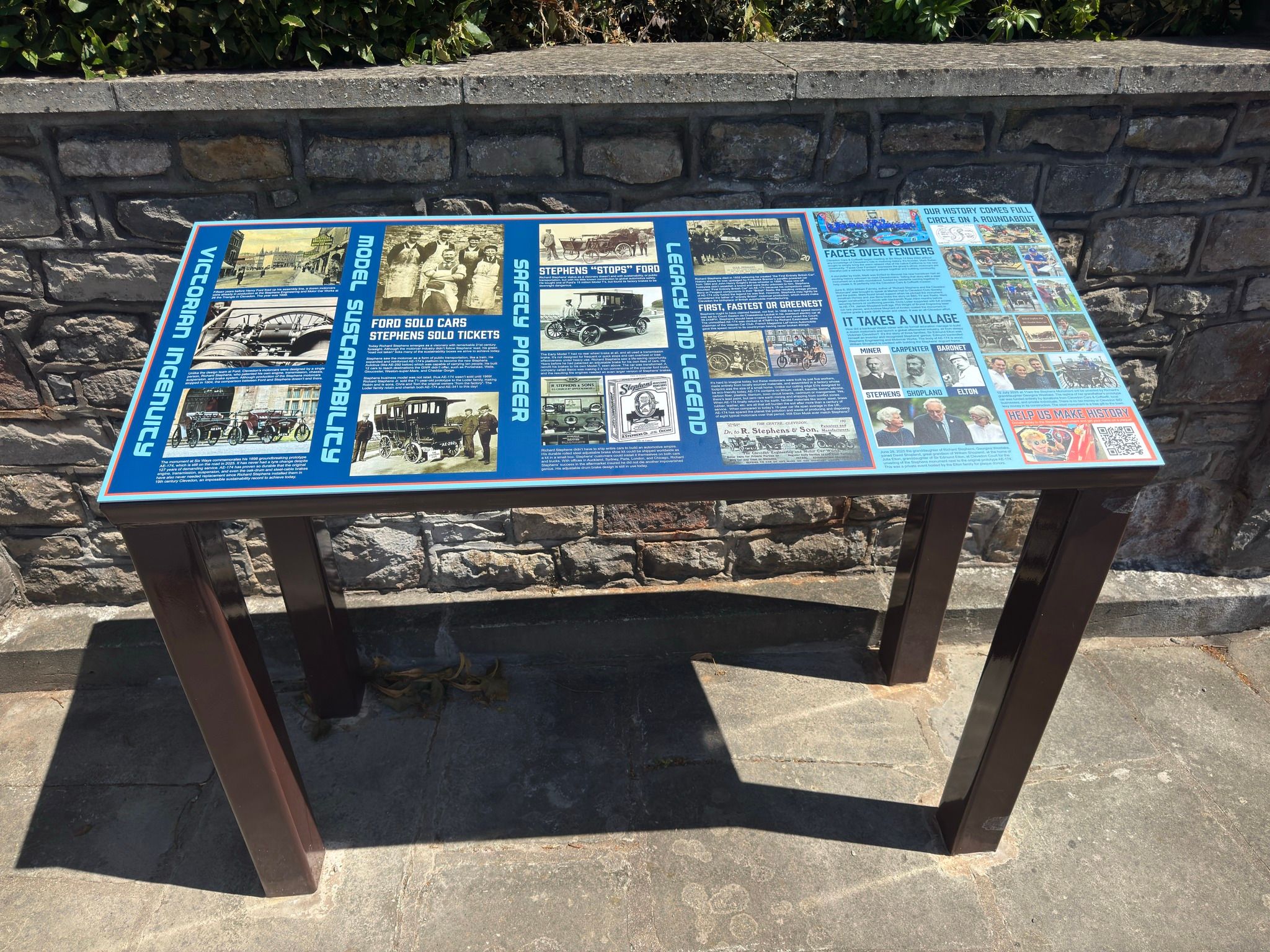
The lectern for the information plaque was donated by one of our members who built it himself - and it's on the pavement rather than on the roundabout by the monument, so people can learn everything about it without having to go out to the roundabout itself.
Tell us about the unveiling
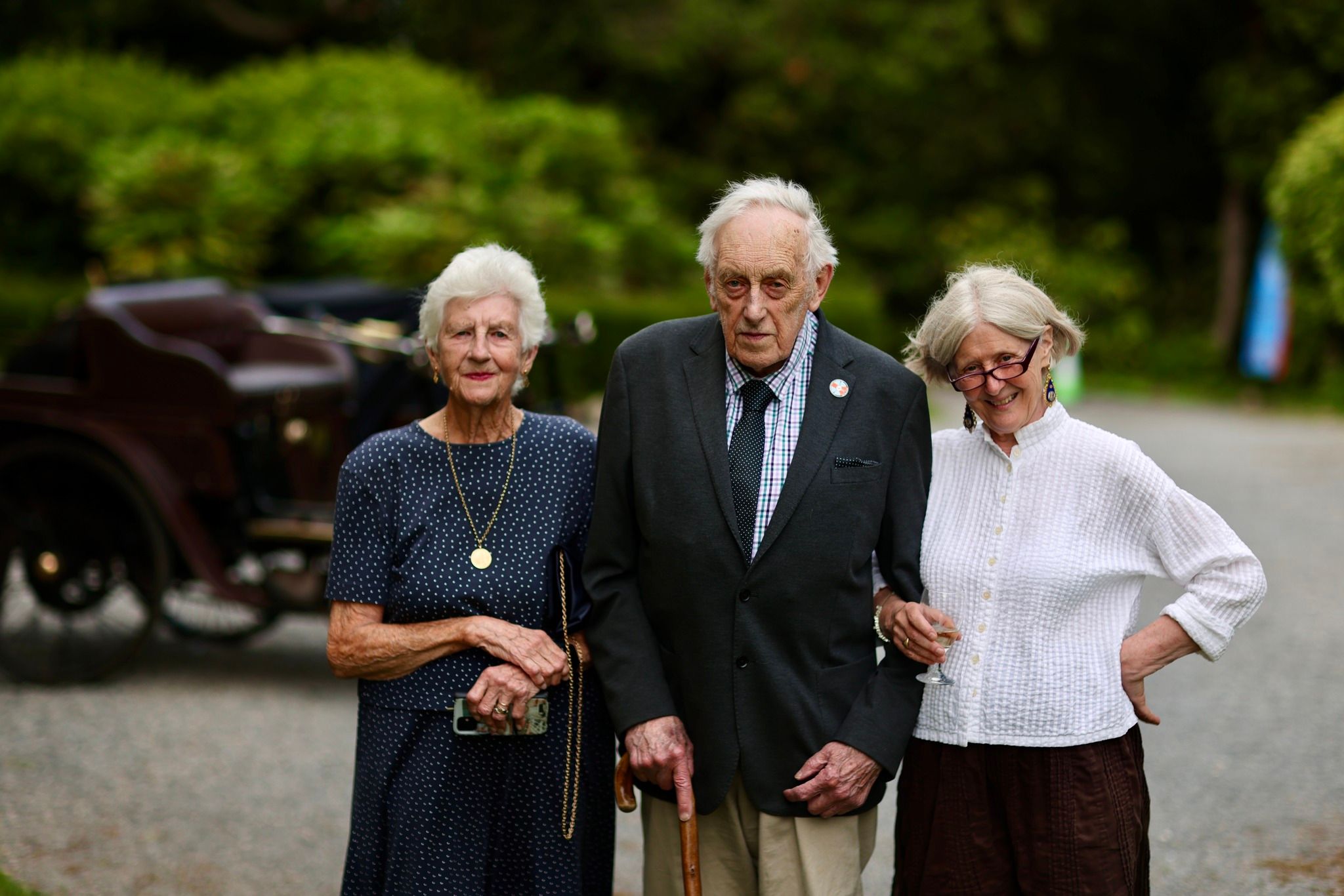
In late June this year, before the public unveiling, Julia Elton hosted an event for donors at her ancestral home, Clevedon Court, where the monument was unveiled to the donors, appearing alongside Chris Loder's Stephens prototype. Representatives of all three families who were integral to the original Stephens car were there - Georgina Westlake, Richard Stephens' granddaughter, David Shopland, great-grandson of carpenter William Shopland and Julia, of course (L to R in image below)
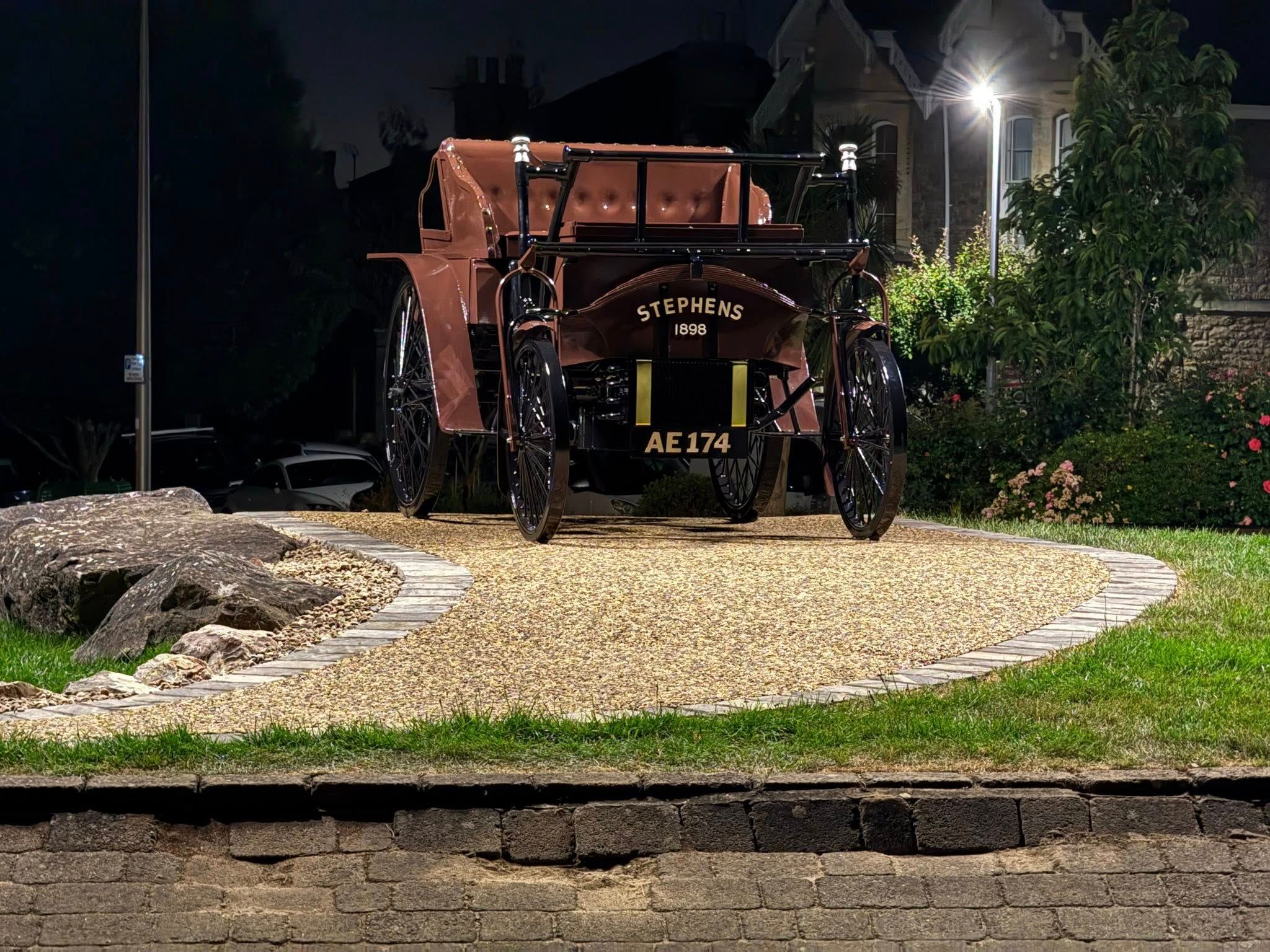
When a car is 128 years old, you have decide which iteration of the car you want to build. For the first half of the car’s life the registration plate was under the radiator, and STEPHENS was written large with the date above in GWR cream. The upholstery had furniture tacks where the leather covered the wood on the armrests and back. I didn’t just have to rely on older photos, Chris Loder kept the original parts including the horsehair stuffed upholstery, so I could count the furniture tacks and Chesterfield buttons from the oldest photos of AE 174.
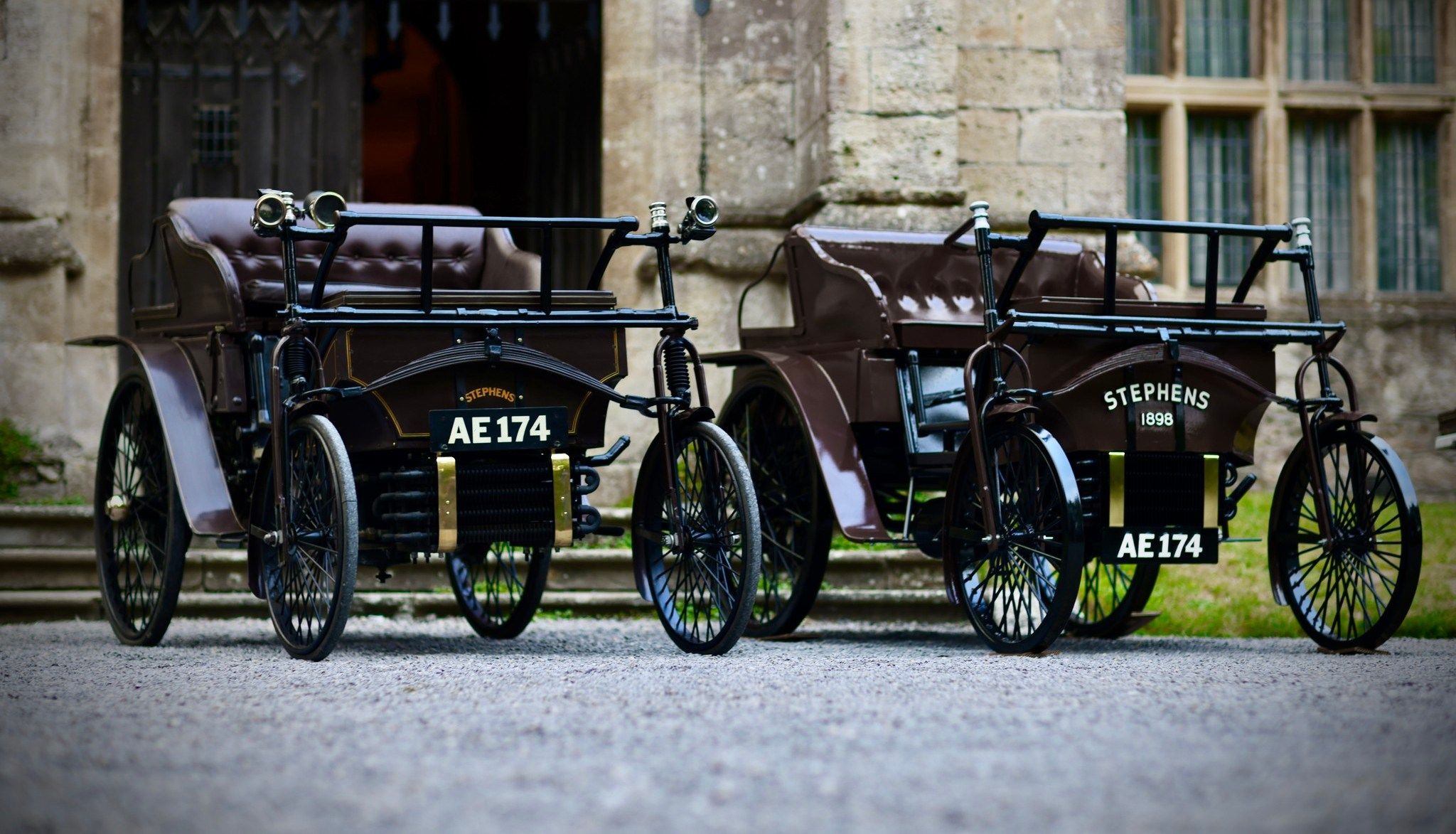
There was a lot of press interest in the project - the BBC covered the story of the unveiling, and we took some great photos of the prototype on Clevedon Pier.
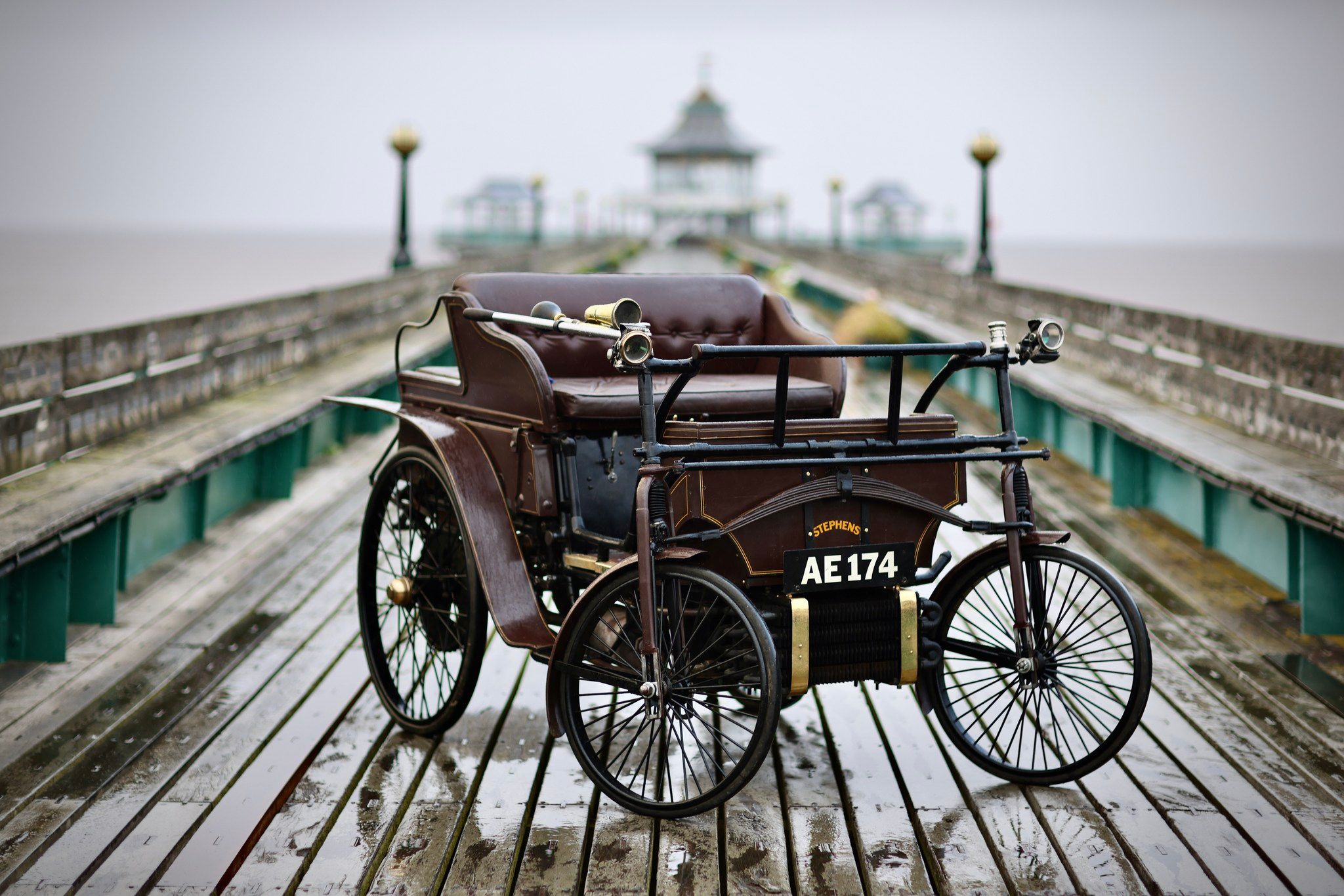
The monument was officially unveiled on the Six Ways roundabout on 12 July. It was a wonderful day - Georgina Westlake was driven around the roundabout in Chris Loder's Stephens prototype - she had last been driven in that very car by her grandfather, when she was 12 years old.
And the reaction from the general public?
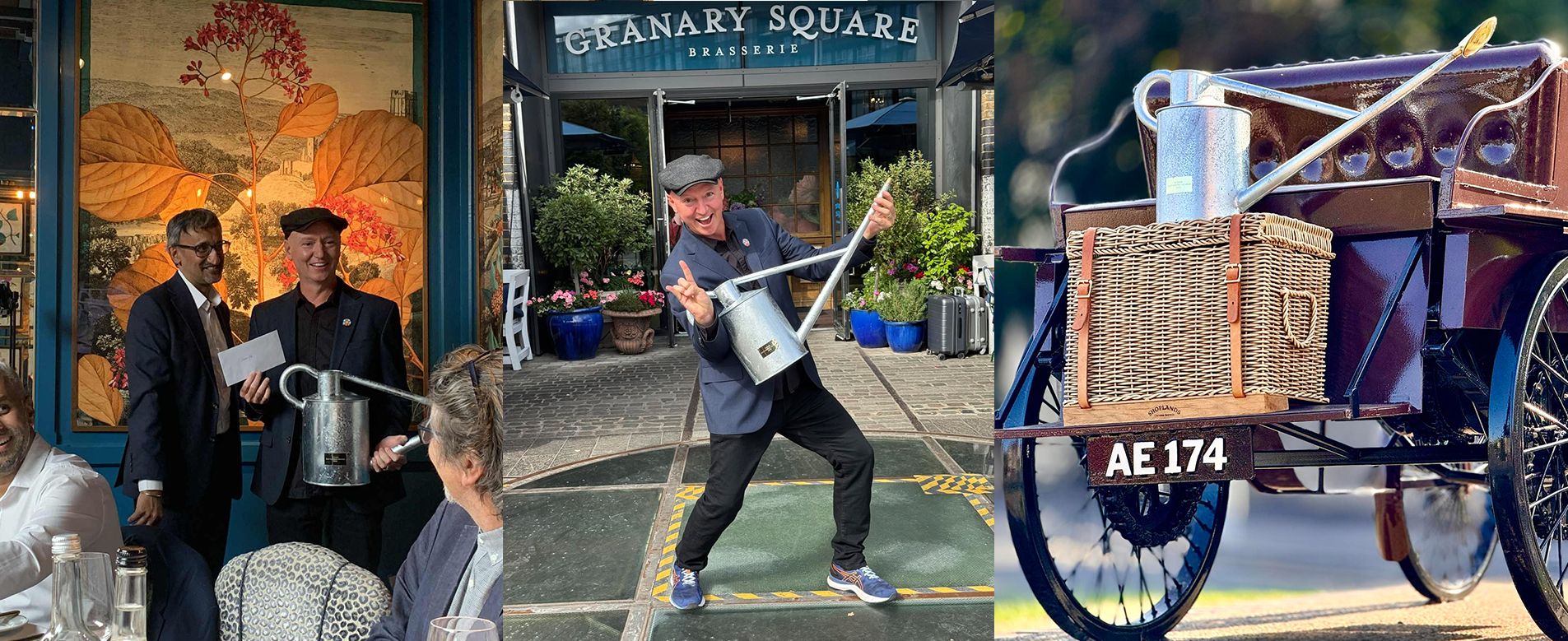
Engagement has been really nice because everybody in Clevedon kind of feels like they own it a little bit. You can go out and touch it. Also, it doesn't have any steel straps or anything holding it down. It looks like it's just parked there and it could drive off at any minute. And it looks delicate, and so people have been really protective of it. But it's tough - people are surprised when they tap the 'wicker' basket on the back. This was built by Dave Townend, and is aluminium with realistic paintwork by my son Conan Reber - so tapping it makes a very different sound to what people expect!
And the monument has already won an award?
Yes! Just a week or so ago it won the Art Category of the GAGA Awards, presented by the Galvanisers Association. The trophy was a galvanised watering can!
Now that the (award-winning) monument is in place, what's next?
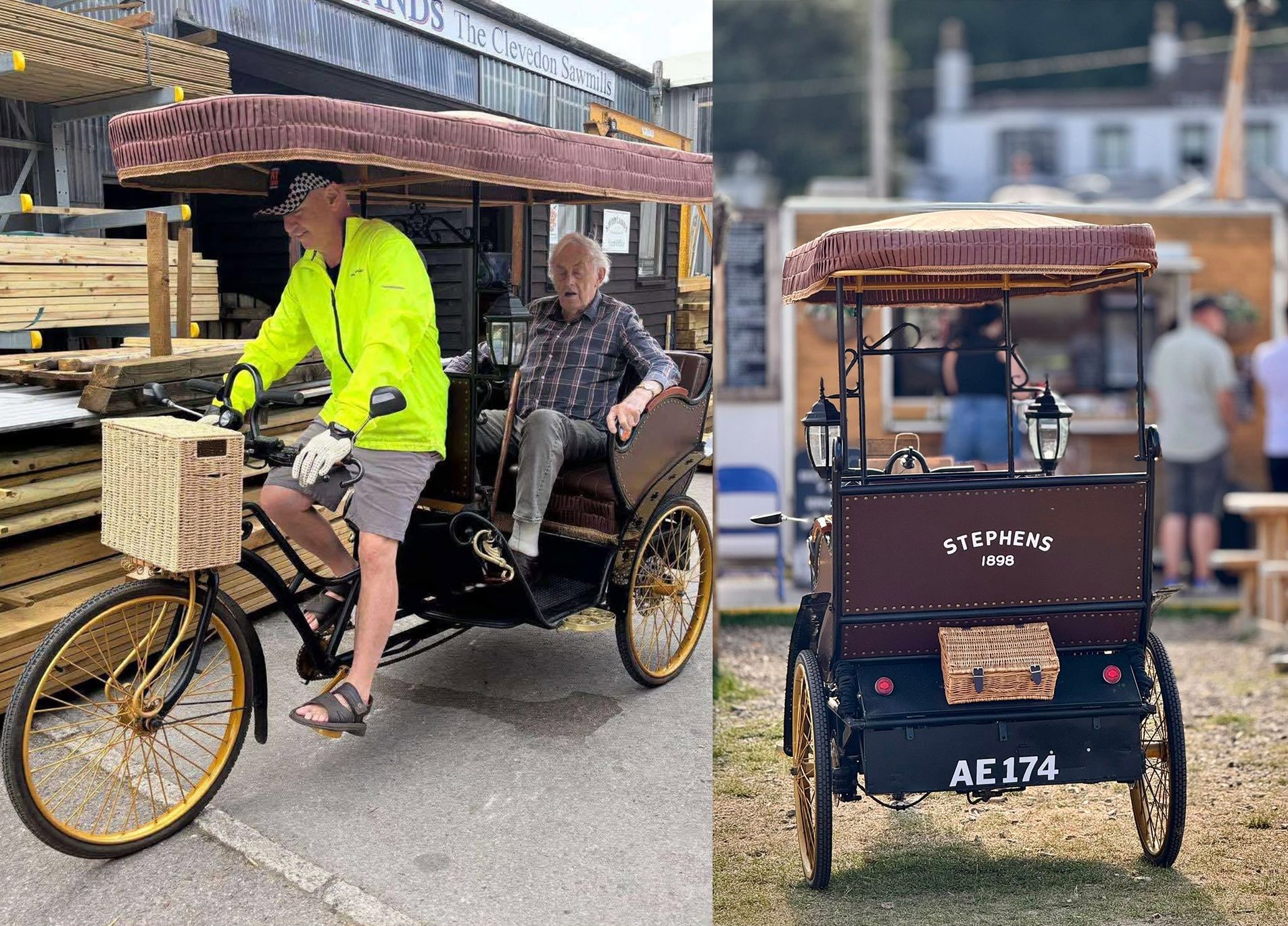
I had the idea of creating an electric rickshaw based on the Stephens car, to revive Richard Stephens' original public transport service operation if you like. People could park on the periphery of Clevedon and then come into the town in a pedicab - a net zero form of transport. The Stephens Pedicab Prototype has been built, and I've offered it to the town for free to take the project forwards if they decide to do so. It would essentially be Clevedon's first park and ride since 1898 - when people could 'park' their horse and hop on board a Stephens' omnibus!
And people love it! Old, young, when we were out and about with the pedicab prototype it turned Clevedon into a Victorian theme park. Some people were kind enough to say that they didn't know the monument actually worked, and thought I was driving it around. What a compliment to the rickshaw, (or perhaps to Somerset cider).
If nothing else, I'll use her every Clevedon Cars & Coffee! She's so much fun and brings magic wherever she goes. Even 95-year-old David Shopland has enjoyed a ride in her!
So that will be the of your Richard Stephens activities?
Um, no...
The late Richard Eastmead, once Chairman of the Veteran Car Club of Great Britain, took part in the Veteran Car Run several times with Robin Loder, who acquired AE 174 and AE 341 from Richard Stephens' son in 1969. During one of those Runs, Richard Eastmead claimed that he clocked the unmodified Stephens prototype at 47mph, which would make it faster than the 1898 land speed record holder, the Jeantaud electric car of the French Count Gaston de Chasseloup-Laubat, who travelled at 39.24mph. There may just be plans to see if Chris Loder can get AE 174 to retrospectively 'take' that 1898 record, with a new 'high speed' run in a few weeks time...
I hope there's more Stephens stories out there to discover. Oh, And that sign - 'The first entirely British-made car' that Stephens displayed on his original cars - made its way to me during the process of building the monument. So I have it now.
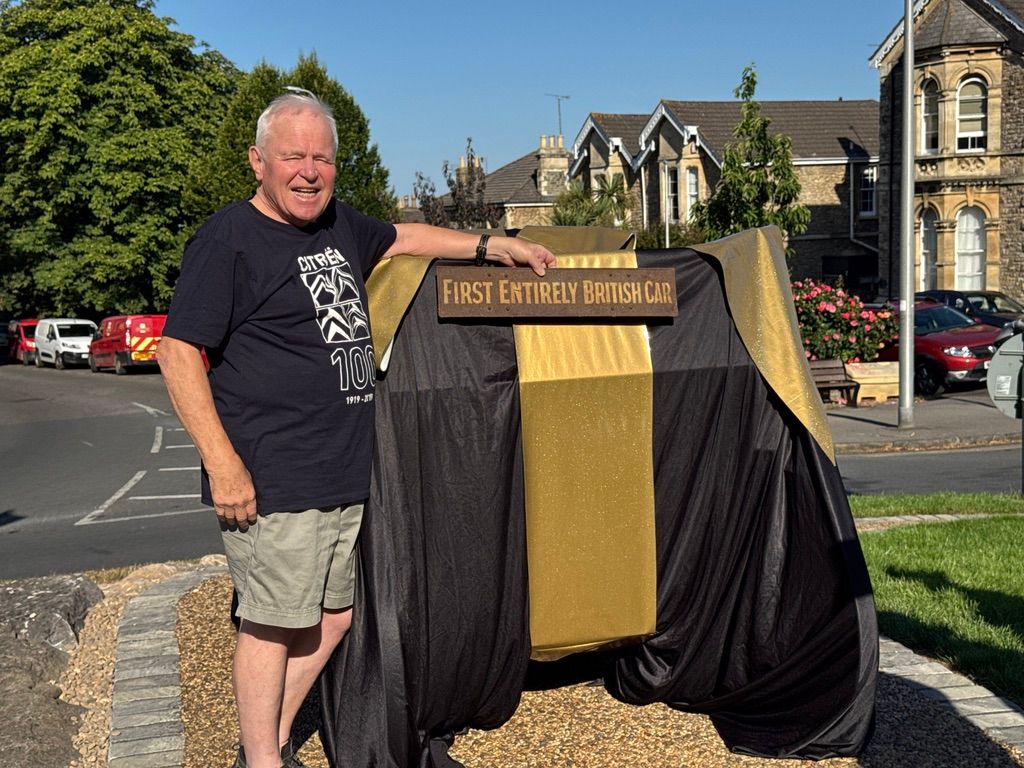
The Stephens monument can be found by visitors to Clevedon, sitting on the Six Ways roundabout, while AE 174 and AE 341 will be making the journey from London to Brighton on November 2 on this year's Veteran Car Run.